3D Printing Creates Efficiencies in Injection Molding
In the plastics manufacturing industry, there has traditionally been a clear distinction between 3D printed parts and plastic injection molded parts.
However, over the past few years, that distinction has become less defined as more injection molders have realized the value of 3D printing not just for prototyping parts or producing small batches, but also for streamlining their own manufacturing processes. While using 3D printing to enhance injection molding results isn’t always standard practice, PCI’s innovative engineers have identified several ways additive manufacturing plays a key role in boosting machine performance.
Before we get into the specifics of these innovative practices, I’ll outline the main differences between 3D printing and injection molding.
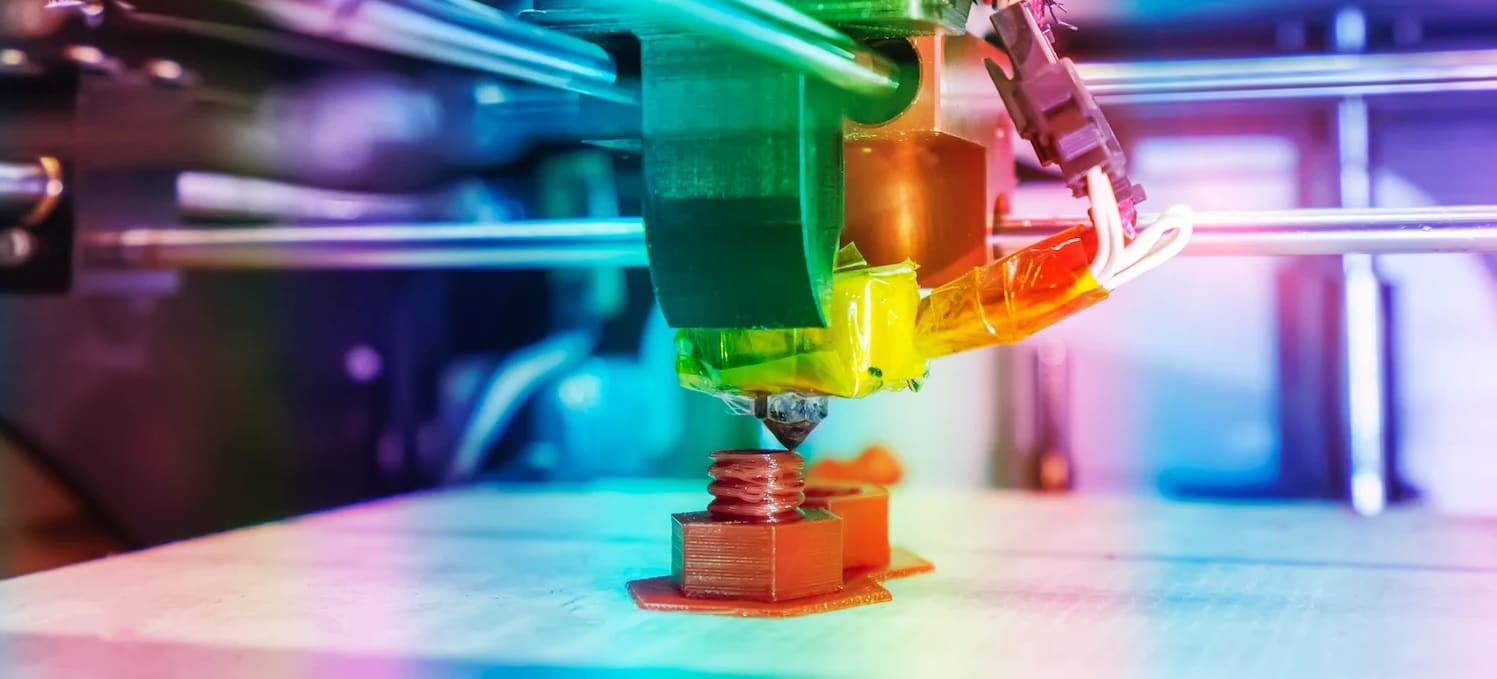
3D printing is an additive manufacturing process where parts are formed by building up layers of plastic (by various methods). This process can be seen in real time, which is often helpful during prototyping and part validation stages.
3D printing is most commonly used for:
- Quick turnaround times (a few hours for a part, or days/weeks for a small batch)
- Low volume production runs (from under 100 to thousands of parts)
- Designs that are still evolving and may need frequent changes or modifications
- Small parts or components that are otherwise hard to manufacture
Injection molding uses steel or aluminum molds where molten plastic material is injected into the mold and cooled to create the finished part.
Injection molding is best suited for:
- Longer turnaround times (5 weeks or more)
- High-volume production (1,000+ parts)
- Parts that have already been approved and tested during prototyping
- Parts of any size
- Parts of any complexity
Discover the complete steps in the injection molding process from design to production in our Injection Molding 101 Guide.
While injection molding is the main process at PCI’s facilities, the team partners with prototype molding providers to create components that can be tested, marketed, or used for short-term or low-volume needs. Additionally, PCI’s engineering team has found several ways that in-house 3D printing, in particular, can increase process efficiency and enhance machine performance for the company.
I had the chance to talk with Engineering Manager, Kurt Behrendt, about how PCI incorporates innovative 3D printing practices.
Q. When did PCI start using 3D printing to support its business processes?
A. PCI has had 3D printing capabilities since 2009. In 2019, PCI expanded those capabilities by purchasing a MarkForged Mark Two 3D printer.
Q. What are some of the main benefits and capabilities of 3D printing?
A. -The ability to quickly and affordably create proof-of-concept samples
-The ability to test ideas/designs for manufacturing
-The ability to make fixtures, brackets, couplings, and even insulator blocks to support various measurement and manufacturing needs
Q. What are some of the main limitations?
A. The MarkForged Mark Two printer meets many of our needs; however, it is limited as a full solution for additive manufacturing. PCI has established relationships with reliable service providers to meet low-volume production requirements through additive manufacturing.
Q. What are the material capabilities and limitations when using 3D printing?
A. The MarkForged Mark Two prints in Onyx (nylon) resin. Additionally, it can weave fibers (carbon, Kevlar, glass) in various ways into the Onyx material to enhance functional properties. This helps our engineers develop creative solutions where strength, wear, or temperature might challenge other 3D printing options.
Q. What are some specific ways or projects where PCI has implemented 3D printing?
A. A lot of our customers already have 3D printing capabilities. However, we still print proof-of-concept samples for part and mold design reviews, and 3D printing is used for a variety of other applications including: automation concepts, quality planning, measurement fixtures, insulation blocks, couplings, and more.
Since purchasing the Mark Two, we’ve been using 3D printing and its structural meshing techniques to build a number of our nests for holding parts for metrology in our CMM and other measurement devices, where constraining the part allows for increased accuracy and improved GR&R results.
We also use 3D printing to make end-of-arm tooling for robotic applications. We can quickly and affordably print custom part holders, insulation blocks, and even couplings. One recent example is a 3D-printed block that provided enough insulation from a 300F mold surface to allow our engineers to specify lower temperature and more robust sensors.
Q. Are you using 3D printing at all to create production efficiencies for your customers?
A. Yes, but it’s most effective when it’s incorporated early in the DFM process. During the design for manufacturing process, PCI often prints samples with alternative geometry for customers to consider for their applications. These samples can lead to production efficiencies (simpler, more robust tooling, reduced cycle times, and/or enhanced quality attributes) throughout the life of the program. In my experience, iterative and collaborative design brings about the greatest production efficiencies, even before a production part is made.
Q. How could 3D printing be incorporated further into your processes in the future?
A. 3D printing has advanced tremendously over the past five years and can now cost-effectively support a wide variety of materials and applications through additive manufacturing. PCI is able to meet these needs through a solutions provider, but there’s potential to invest in in-house additive manufacturing if the marketplace demand becomes significant.
Q. Why is it important to work with an injection molder who truly understands 3D printing capabilities?
A. Our experience at PCI is that 3D printing encourages innovation by eliminating the cost and lead-time restrictions of other manufacturing methods. For example, our team now prints quality fixtures for a tenth of the cost of machined aluminum ones—and they’re available in as little as one day. If the fixture needs more engineering, we can simply revise the design and print another, again, within a day. This speed and flexibility allow our engineers to quickly iterate concepts without concerns about cost. While this example specifically references measurement fixtures, this open-ended concept validation process helps engineers tackle part design, tooling, and robotic challenges for our customers.
Would you like to learn more about how PCI uses 3D printing to enhance manufacturing processes? Or how this resource can help meet your need for complex, high-quality plastic parts? Contact our experienced team of plastics engineers today.