What is In-Mold Labeling?
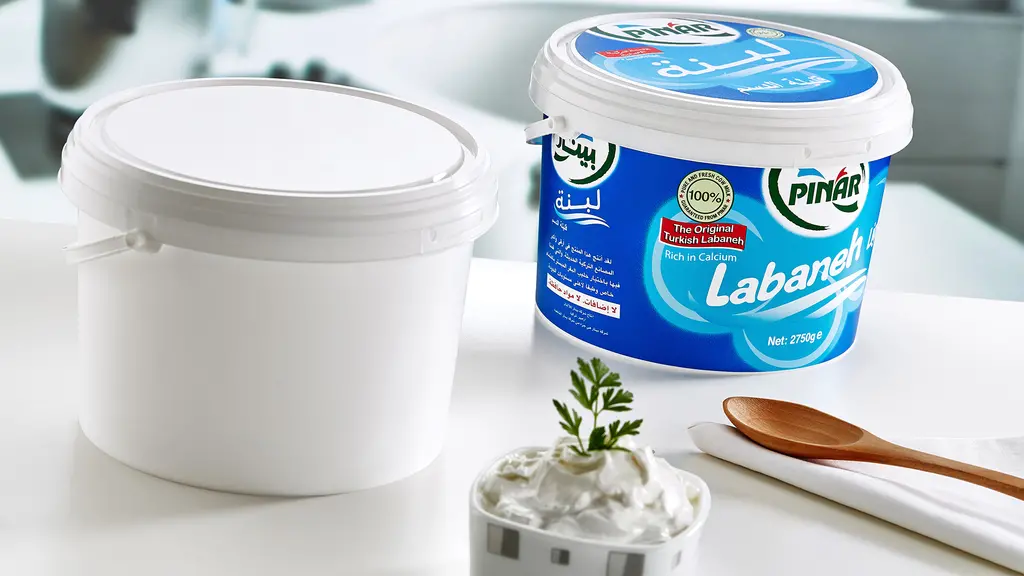
In-mold labeling (IML) is a manufacturing technique where a pre-printed label is placed directly inside a mold before plastic injection. During the In-Mold Labeling injection molding process, the molten plastic fuses with the label under heat and pressure, making the label a permanent part of the finished component.
Unlike traditional labeling methods, where stickers or graphics are applied after production, in-mold labeling integrates decoration directly into the injection molding cycle. This eliminates post-processing steps, improves durability, and ensures consistent quality across high-volume production.
For OEMs, product designers, and packaging engineers, IML provides a reliable solution for combining branding, functionality, and structural performance in a single automated process.
What is the In-Mold Labeling process?
The In-Mold Labeling process is integrated into the standard injection molding cycle. Instead of applying a label after the part is manufactured, the label becomes part of the molded component itself.
The process typically follows three main stages:
- Label placement
- Injection molding
- Cooling and ejection
This seamless integration ensures the label bonds permanently to the plastic substrate without adhesives or secondary operations.
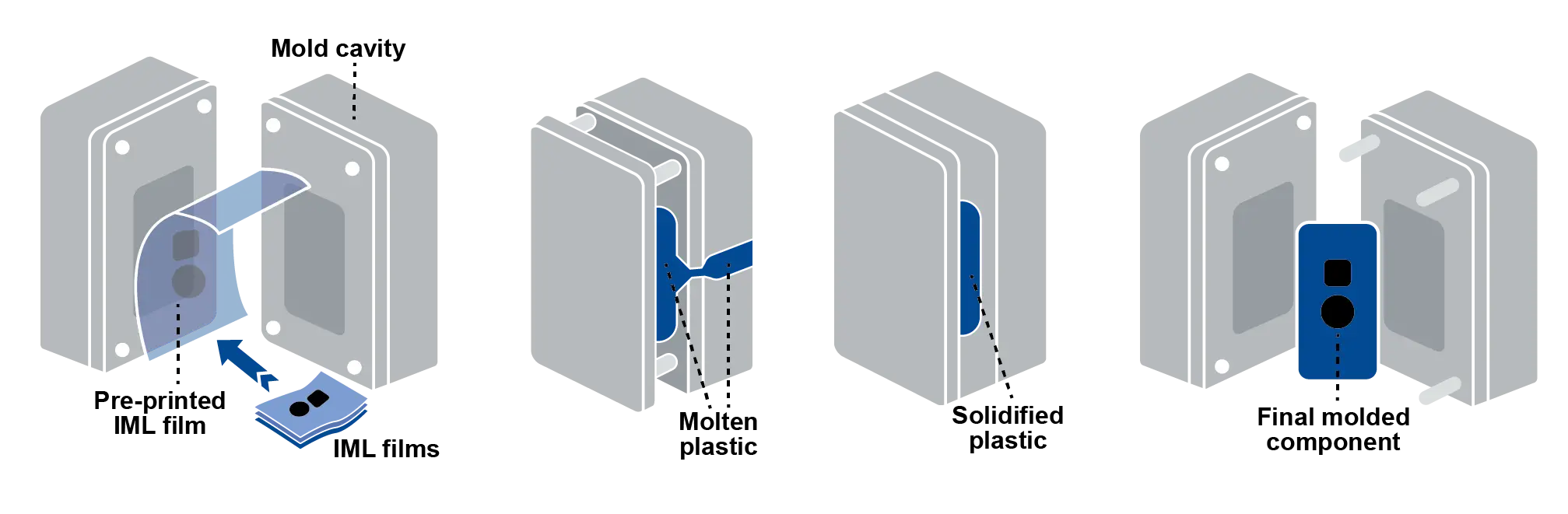
Step 1 – Label placement
The process begins with pre-printed in-mold label films. These labels are usually made from the same polymer family as the molded component, commonly polypropylene (PP).
Before the mold closes, the label is positioned inside the mold cavity using:
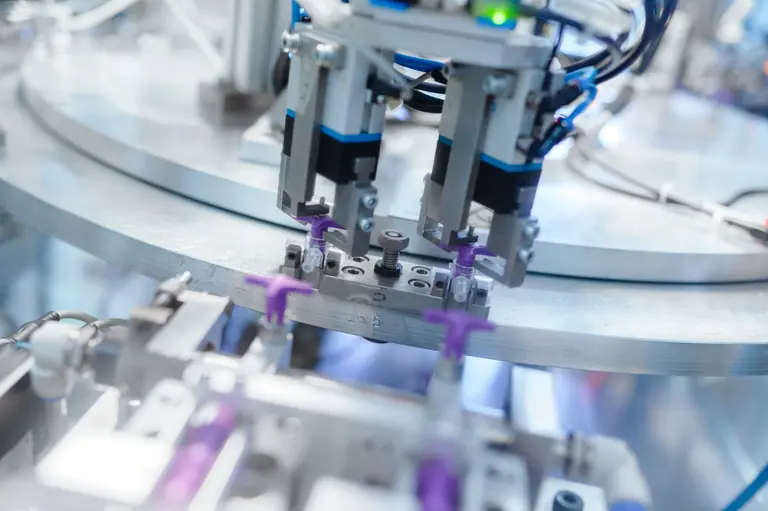
- Robotic automation systems
- Vacuum pick-and-place units
- Static charge placement
Precision is critical at this stage. Accurate alignment ensures the label sits perfectly within the cavity and avoids defects such as wrinkles or misalignment during injection.
Automation systems are typically integrated into the molding cell to maintain high repeatability and consistent cycle times.
Step 2 – Injection molding
Once the label is correctly positioned, the mold closes and molten thermoplastic is injected into the cavity.
During this stage:
- The molten polymer flows behind the label
- Heat and pressure bond the label to the plastic
- The label and substrate fuse together into a single structure
Because the label material is compatible with the base resin, the bond forms without adhesives or additional finishing steps.
This integration is what differentiates IML in-mold labeling from traditional decoration techniques.
Step 3 – Cooling and ejection
After injection, the plastic cools inside the mold until the component solidifies.
When the mold opens:
- The finished part is ejected
- The label is already permanently bonded to the surface
- No additional decorating or labeling process is required
The result is a fully finished component leaving the mold ready for use or packaging.
In-Mold Labeling Injection Molding vs. Traditional Labeling
Traditional labeling methods typically involve applying a printed sticker or sleeve after the part has been produced. This requires additional production steps, equipment, and handling.
In contrast, in-mold labeling integrates decoration directly into the molding cycle.
Key differences include:
| Feature | In-Mold Labeling | Traditional Labeling |
|---|---|---|
| Application stage | During molding | After production |
| Adhesives required | No | Yes |
| Durability | Very high | Moderate |
| Production steps | Single integrated process | Multiple steps |
| Automation compatibility | High | Often manual or semi-automated |
Because the label becomes part of the plastic component, IML offers greater durability, improved efficiency, and better consistency in high-volume manufacturing.
Key Benefits of In-Mold Labeling
The advantages of in-mold labeling make it particularly attractive for OEMs producing high-volume plastic components or packaging.
Superior Durability
IML labels are fused directly to the plastic surface, which provides excellent resistance to:
- Scratches
- Moisture
- Chemicals
- UV exposure
This makes the technology suitable for demanding environments such as food packaging, consumer goods, and industrial applications.
Design Flexibility
IML enables advanced visual and tactile design options, including:
- 360-degree decoration
- Metallic or matte finishes
- High-resolution graphics
- Textured surfaces
This allows brands to achieve premium visual effects while maintaining production efficiency.
Cost Efficiency at Scale
Although the initial tooling investment may be higher, IML eliminates secondary labeling operations. This leads to:
- Reduced labor requirements
- Faster production cycles
- Lower total manufacturing costs at scale
For high-volume production, the process becomes extremely efficient.
Sustainability
One of the main sustainability benefits of in-mold labeling (IML) is mono-material compatibility.
Because the label and base material are often made from the same type of polymer, the finished product:
- Is easier to recycle
- Requires fewer additional materials
- Generates less manufacturing waste
This supports circular economy initiatives throughout the industry.
Automation compatibility
IML is highly compatible with automated manufacturing systems. Robotic label placement provides:
- Consistent positioning
- Reduced human error
- Highly repeatable production
For global manufacturers, this level of automation supports scalable production across multiple facilities.
What materials are used in In-Mold Labeling?
Material compatibility is crucial for successful in-mold labeling injection molding.
The most common combination includes:
- Polypropylene (PP) for both the label film and the base resin
- Thin label films typically ranging from 50–100 microns
Using matching materials ensures that the label and component properly bond during molding.
For this reason, early design-for-manufacturing (DFM) collaboration between designers, material specialists, and molding engineers is essential.
Factors considered during development include:
- Adhesion characteristics
- Material shrinkage
- Melt flow behavior
- Label thickness
In-Mold Labeling in blow molding vs injection molding
Although IML is most often associated with injection molding, it can also be used in blow molding processes.
Injection Molding
Injection molding offers:
- Greater dimensional precision
- Complex geometries
- Structural components with integrated decoration
This makes it ideal for technical parts, lids, containers, and branded consumer products.
Blow Molding
In blow molding, IML is often used for:
- Bottles
- Containers
- Thin-walled packaging
However, blow molding generally offers less geometric complexity and lower precision compared to injection molding.
As a result, in-mold labeling injection molding remains the preferred solution for high-precision applications.
Design Considerations for In-Mold Labeling
Successful IML implementation requires careful engineering during the product development phase.
Key considerations include:
Label thickness
The label must be thin enough to conform to the mold surface while maintaining structural integrity.
Gate location
Proper gate placement ensures the plastic flow does not distort or displace the label.
Flow patterns
Resin flow must distribute evenly behind the label to prevent wrinkles or air pockets.
Venting
Adequate venting allows trapped air to escape during injection.
Surface finish
The mold surface must support proper label adhesion and visual quality.
Early supplier involvement is essential to optimize these factors and reduce development risks.
When should you choose In-Mold Labeling?
IML is particularly beneficial for products that require durable branding combined with high-volume manufacturing efficiency.
Typical use cases include:
- Consumer packaging containers and lids
- Household product packaging
- Food containers
- Automotive interior components
- Medical and pharmaceutical packaging
In general, in-mold labeling is ideal when production volumes are high and product appearance is critical.
Partnering with an experienced IML manufacturer
Implementing in-mold labeling in injection molding requires expertise in tooling design, materials engineering, and automated production systems.
Experienced manufacturing partners support OEMs through:
- Design-for-manufacturing optimization
- Material selection
- Tool design and validation
- Process automation
- Global production scaling
From concept development to full-scale manufacturing, this collaborative approach ensures consistent quality, reduced risk, and faster time to market.
Discuss your In-Mold Labeling project
If you’re considering In-Mold Labeling for your next plastic component, early engineering collaboration can significantly improve performance, cost efficiency, and scalability.
Discuss your In-Mold Labeling project with our team and partner with Rosti, your global plastic injection molding leader, to explore how IML can support your product design and production goals.
Or learn more about the fundamentals of manufacturing in our Plastic Injection Molding Guide.