E-mobility Guide

Rosti partners with some of the world’s leading producers to tackle manufacturing challenges in e-mobility.
This is a rapidly growing sector—driven by environmental pressures and government regulations—and we’re helping bridge the gap from prototype manufacturing to mass production.
Injection molding for e-mobility
Thanks to our extensive design capabilities, Rosti has been challenged to create complex molds and in-mold features for mass manufacturing in the rapidly expanding e-mobility sector.
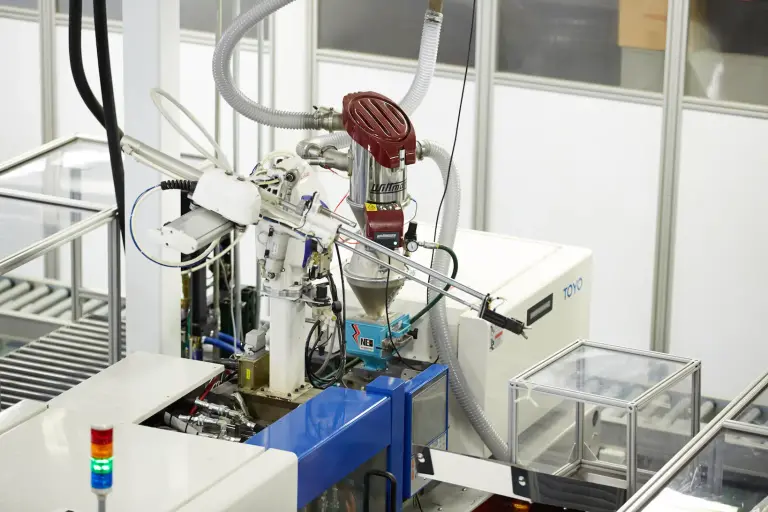
Injection molding offers significant advantages in this industry, with applications for electric bikes, scooters, public transport vehicles, and cars. It’s a repeatable, cost-effective, lightweight, and fast process, and production can easily be scaled up or down. These are ideal qualities when aiming to ensure reliable quality in high-volume production.
The modern battery carrier
The modern battery carrier is now a vital part of effective thermal management in electric vehicles. Manufacturers face the challenge of keeping multiple batteries cool without relying on forced air cooling. This has led to the introduction of a special channel structure inside the battery carrier that allows cooling fluid to flow through or around the battery cells. The carriers that Rosti has co-designed include a channel structure that also enables transient cooling.
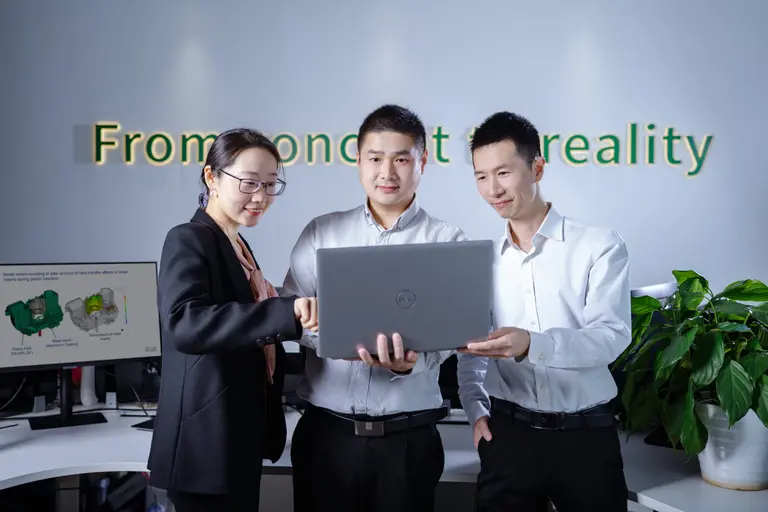
Rosti partners with OEM clients to provide packaged solutions in this field. Using our in-house, state-of-the-art mold-flow simulation software, we help clients take their ideas from concept to reality. Half a billion carriers will be needed to meet the future demands of the electric vehicle market. At Rosti, we’re very proud to be leading the way.

Read more about our e-mobility projects below or download this white paper.
Why injection molding is the perfect solution for mass-manufacturing e-mobility applications
Many factors are driving the rapid development of e-mobility, not least government regulations and environmental pressures. Plus, with the global commercial electric vehicle market expected to grow at a compound annual growth rate of 39.9%—from 125,212 units in 2017 to 1,831,865 units by 2025—e-mobility research and development is speeding ahead like never before.
Traditional internal combustion engine technology for powering vehicles is losing ground, with today’s OEMs developing new platforms across the light-, medium-, and heavy-duty e-mobility markets. These platforms are expected to perform just as well as their traditional counterparts. That’s not the only challenge, though; it’s equally demanding to make the leap from today’s low-volume prototype manufacturing using emerging technologies to tomorrow’s needs for mass production.
Rosti is already involved in the e-mobility/battery market and is working with some of the world’s leading OEMs to use proven production techniques to tackle today’s manufacturing challenges head-on. One such challenge is the battery pack carriers used in e-mobility platforms. Battery technology is key for making vehicles run longer, and the not-so-simple battery carrier plays a major role. In this article, Tony Austin, Technical Director at Rosti, discusses issues surrounding battery technology and explains why injection molding should be the top choice for OEMs as a manufacturing process.
The battery carrier’s role: past and present
Looking under the hood of any conventional ICE-powered vehicle will show that the battery carrier is a fairly static component. Usually made of metal, its main job has been to support the traditional lead-acid battery and offer some protection if there’s an impact. But as e-mobility vehicles have evolved, the battery has become the heart of the system.
Both vehicle reliability and range depend on the battery technology used, so anything that threatens battery performance—like hot climates—must be addressed. Basically, a rise in ambient temperature shortens e-mobility battery life: the hotter the batteries, the faster the chemical reactions and the sooner the battery will discharge.
Independent tests have found that a battery’s self-discharge rate doubles with every 10°C rise in temperature. It’s also crucial to protect batteries from overheating, which is the worst-case scenario and can cause rapid damage.
Quote Style
“Independent tests have shown that the self-discharge rate of a battery doubles every time the temperature rises by 10°C”
Introducing the 21st-century battery carrier
The modern battery carrier is now a key factor in effective thermal management, and e-mobility OEMs are looking for new ways to keep multiple batteries cool and move away from traditional forced-air cooling. This has led to the introduction of a special channel structure within the carrier that allows cooling fluid to flow through or around the cells. What’s more, this channel structure allows for transient cooling.
Rosti is partnering with OEM clients to provide packaged solutions for this. The latest battery carrier designs are often highly complex, making it difficult to produce a finished component using traditional manufacturing methods such as CNC machining or pressing. It’s also important to point out that 3D printing—which is seen as a breakthrough for the future—still has limitations in terms of the capital investment needed. It also can’t meet the industry’s demand for high-volume production. So, what’s the alternative?

Injection molding for electric vehicle battery carriers
In the injection molding process, source material is melted and injected into a mold at high pressure. The part cools in the mold and is ejected before the process starts again. But is injection molding the best manufacturing process for electric vehicle battery carriers? For years, Rosti has faced challenges from many OEMs—across various markets—to design complex molds with many in-mold features, an expertise that would almost certainly be needed for battery carriers used in e-mobility applications. For instance, Rosti can design the cooling channels as an integrated part of the molding. Using in-house, state-of-the-art mold-flow simulation software, Rosti can take ideas from concept to reality, producing in a single pass a part that has all the required features for a 21st-century battery carrier.
But again, is injection molding really the right manufacturing process for battery carrier applications? Another way to approach this question is to consider the potential volumes needed. If e-mobility reaches its full potential based on unit forecasts, then production volumes will be extremely high. This number must also account for the large amount of spare battery packs—and therefore carriers—that will be needed, as well as power supplies required for other markets.
Rosti suggests that neither CNC machining nor 3D printing will be able to handle these large volumes or deliver the target piece-part costs expected by OEMs. Instead, a repeatable, cost-effective, and fast process that provides structural rigidity is required. This is where injection molding offers significant advantages, including the ability to scale production as needed.
It’s true that upfront costs for injection molding can sometimes be slightly higher because of tooling requirements, but the engineering benefits and economies of scale must be considered. Once upfront costs have been amortized, the cost per unit with injection molding is highly competitive. Moreover, the process is very repeatable—a valuable trait when aiming for brand consistency and part reliability in high-volume production. Another benefit is that injection molding can reduce the total number of parts needed since it allows for integration of ancillary components like brackets. This design freedom clearly benefits the bill of materials and reduces production assembly time.
Does injection molding offer the right materials?
For this application, it’s essential to involve the raw material producer from day one of the project. For example, there’s a strong need to reduce weight in battery carrier applications; since it’s not possible to make battery cells lighter, the carrier itself must be lightened. While injection-molded solutions provide a lighter alternative to traditional metal carriers, will these parts have the strength needed to support the battery and protect it from external factors? Rosti’s thorough consultations with raw material manufacturers ensure the right material composition is used—one that delivers all the requirements for thin yet strong wall construction. In addition, the specified material always meets the UL-94VO flammability resistance standard, providing assurance of regulatory compliance in application.
Conclusion
As the world moves toward an e-mobility future, mass manufacturing is the next big challenge. Rosti believes that injection molding has a significant role to play, and through close cooperation with OEMs, a technology from the 20th century just might offer a solution for the 21st.