Scientific injection molding: a guide to the process
Scientific injection molding replaces trial and error with a repeatable, data-driven process. This guide explains the method, how it differs from conventional molding, the four plastic variables it relies on, the technology and people behind it, and why process discipline matters when you choose a molding partner, with examples from Rosti’s Wisconsin operations.
In this guide:
- What is scientific molding?
- Scientific molding compared with conventional molding
- The four plastic variables: heat, pressure, flow, and cooling
- Steps in the scientific molding process
- Two-stage and three-stage decoupled molding
- Advantages of scientific molding
- The technology behind scientific molding
- Automation and lights-out manufacturing
- The people: engineers and technicians
- Design for manufacture and material selection
- Does scientific molding cost more?
- Why Rosti for scientific molding?
- FAQ
What is scientific molding?
Scientific molding, also called scientific injection molding, treats the fill, pack, and hold stages of the cycle as separate steps. Each stage is controlled independently, which reduces variation and improves consistency from one part to the next. The industry term for this separation is decoupled molding.
Scientific molding combines equipment, software, and process. Molders who adopt it can shorten cycle times, use each machine more efficiently, and reduce rejects.
Scientific molding compared with conventional molding
In conventional molding, pressure is the primary control for the whole fill and pack, with speed as the secondary control. Small changes in viscosity or temperature therefore pass directly into part dimensions. In scientific molding, the cavity is filled under velocity (speed) control up to a transfer point, and the machine then switches to pressure control to pack out the cavity.
The transfer point depends on the method and the part. In a three-stage decoupled process, the first stage fills to about 80 to 85%, while a two-stage process transfers at a higher fill level.
| Conventional molding | Scientific molding | |
| Fill control | Pressure-primary fill and pack in one stage | Velocity-controlled fill to a transfer point, then pressure-controlled pack |
| Consistency | Greater variation from cycle to cycle | Shot-to-shot consistency |
| Basis for decisions | Machine settings | The plastic’s own heat, pressure, flow, and cooling behavior |
The gap matters most on complex parts, where small changes in a molding variable can significantly shift the outcome. A scientific approach aims at two things:
- Developing a process that gives repeatable results with minimal variation
- Optimizing the dimensional and mechanical properties of the molded part
The four plastic variables: heat, pressure, flow, and cooling
For many years, molding problems such as dimensional drift, voids, and warpage were traced to individual machine settings. That link proved weak in practice. Attention moved from the machine to the plastic itself—an approach often called the “plastics point of view.” It rests on physical laws rather than machine parameters.
This approach groups the processing stages that govern a molded part’s properties into four variables: heat, pressure, flow, and cooling. Each is governed by established physical laws, including the laws of heat transfer, Poiseuille’s law for fluid flow, and the equation of state for plastics. The same physical principles that apply to other materials apply to plastics processing, and together the four variables determine the character of the finished part.
Understanding machine setup still matters. The four-variable approach gives the molder a firmer basis for setting controls, maintaining cycle times, and diagnosing part issues when they occur.
Steps in the scientific molding process
Scientific molding divides the cycle into stages so that each one can be controlled individually. Process control tools that use in-mold pressure sensors monitor the cycle based on the plastic’s heat, pressure, flow, and cooling behavior, all overseen by trained process engineers. The cycle is broken down into three steps:
- Initial shot: the cavity fills to about the transfer point, with velocity as the main control parameter.
- Fill and pack: the cavity completes filling and is packed under pressure control. With in-mold pressure sensing, this stage is managed using the actual pressure inside the mold instead of just machine parameters, creating a more robust process window.
- Cool and stabilize: the part cools and stabilizes before ejection, and the machine resets for the next metered shot.
The result is better control of part dimensions and, more importantly, consistent shot-to-shot results: the same outcome every cycle, instead of a range of acceptable results.
Two-stage and three-stage decoupled molding
Decoupled molding separates fill, pack, and hold, instead of running them as one continuous, pressure-driven shot. Two versions are commonly used:
- Two-stage decoupled molding: the mold is filled to a transfer position, then packing and holding are combined in a second-stage pressure phase that packs out the cavity and holds until the gate seals.
- Three-stage decoupled molding: the cavity is filled in a speed-controlled stage, packed under velocity control to a cavity pressure set point, then held until the gate seals.
In-mold pressure monitoring and control systems work with both methods. They give process engineers real-time visibility into the variables that determine which method fits a specific tool. Through in-mold pressure sensors, they provide the exact control needed to run either one consistently, shot after shot.
Advantages of scientific molding
Without scientific molding, you’re left with variation: changes in temperature, pressure, and viscosity, longer cycles, less efficient machines, higher costs, and more rejects. When run correctly, scientific molding delivers:
- Consistent, repeatable part quality from shot to shot
- Faster cycle times
- Greater machine efficiency and utilization
- Fewer rejected parts
- Lower overall production cost
- Full process traceability, with automated containment where needed
This technology gives molders a real competitive edge, and their customers get higher-quality parts with fewer rejects at a lower cost. At its core, scientific molding solves one main problem: getting an injection molding machine to produce a good part, every single time.
The technology behind scientific molding
Scientific molding is rooted in physics but delivered through engineering, equipment, and software. Two key technologies do most of the work at Rosti.
Mold flow simulation
Rosti uses most major mold flow simulation systems, including Moldex3D, Ansys, Autodesk Moldflow, and SOLIDWORKS, as a front-end design validation tool. It provides predictive insights into a component’s design before it reaches the tool shop. Used well, it:
- Shortens the product development cycle by identifying design issues early
- Gives a clearer picture of plastic part behavior than would otherwise be practical or affordable to predict
- Flags potential defects such as sink marks, weld lines, and short shots before they turn into expensive mold rework
The result is a part design that works the first time, avoiding costly mold changes and protecting quality and schedule.
In-mold process control
Closed-loop in-mold process control has transformed how Rosti operates its presses.
Rosti first installed in-mold process control on a small number of presses, and the results were strong enough that the company decided to equip every press. Closed-loop process control is now a core part of how Rosti operates, rather than a one-time upgrade.
The main benefits Rosti has experienced from in-mold process control:
- Historical data logged for every shot
- Real-time production monitoring, so interventions happen before parts go out of spec
- Measurable improvements in quality assurance and part consistency
- Reductions in scrap and processing time.
- Automation and lights-out manufacturing
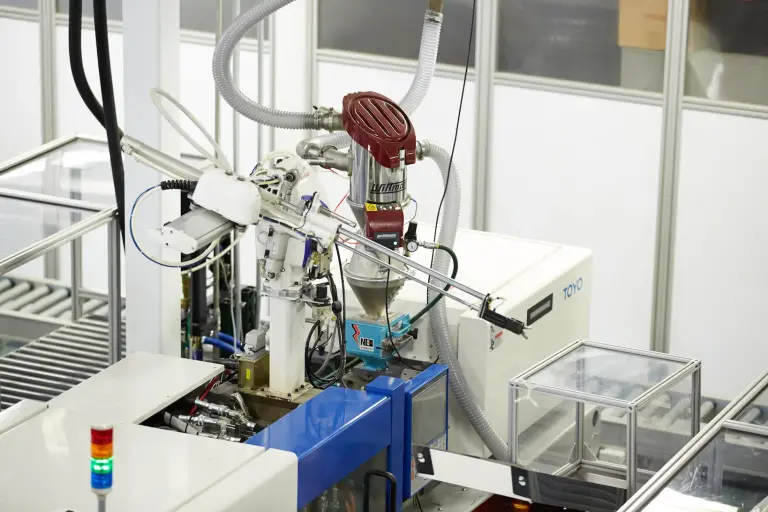
Automation and robotics have transformed most manufacturing sectors, and injection molding is no exception. The more a molder can automate, the more it can grow and compete globally. The clearest example is a fully automated, lights-out facility, designed to run with minimal human presence on the shop floor.
Rosti has operated one since 2011 at its Bunsen Drive site, which is now part of Rosti Wisconsin. The facility’s layout places machines on the ground floor and resin supply on a mezzanine above.
A lights-out facility performs tasks that would normally require a person to be present, keeping production running 24/7 with no need for shift handovers. Rosti Wisconsin demonstrates what this looks like in practice and delivers the broader benefits of lights-out manufacturing:
- A competitive advantage for molders who invest in it
- Large orders completed quickly, without the extra cost of additional shifts
- Quality, delivery, and cost goals met consistently
- A highly trained workforce, because automation at this scale still depends on the people running it
None of this happens on its own. Mold-fill simulation, in-mold process control, material handling, part conveyance, robotics, and a lights-out facility only work together because skilled people design, monitor, and maintain them.
The people: engineers and technicians
The physics and technology only provide value with the right people in place. Rosti’s approach to building that team includes:
- An internship program, with two to four interns each summer, to keep a steady flow of future talent coming through the business
- Targeted recruitment from schools that combine theoretical and hands-on scientific molding training
- Ongoing in-plant training in scientific molding, covering two-stage and three-stage decoupled principles, pressure sensor specification, and reading process-control output
- A four-level curriculum that takes new hires from molding basics to advanced scientific molding skills, supported by mentoring from Rosti’s experienced in-house process engineers
Rosti engineers are involved throughout the entire process window, not just at start-up. Their work begins at the design stage, covering both the part and the tool, and determining how pressure sensors will be integrated into new molds.
Once a tool is equipped with sensors, it is tested under engineering supervision to identify the variables needed for a stable, optimal process.
With input from senior process technicians, engineers determine whether a two-stage or three-stage decoupled process fits a given mold, validate the process for PPAP (Production Part Approval Process), and continue monitoring output once production is underway.
Design for manufacturing and material selection
Design decisions made before a tool is cut account for a large share of a part’s cost. Boothroyd Dewhurst, which first commercialized design for manufacture and assembly (DFMA) methods and software tools, estimates that around 80% of the cost of a new product is determined at the design stage. The earlier a toolmaker or molder is involved, the better they can catch problems while they’re still inexpensive to fix.
Design for manufacturing and assembly
Rosti’s design support covers three areas. Design for manufacturing controls production cost and catches problems at the design stage, where they’re cheapest to resolve. Design for functionality ensures a part meets its real-world demands, such as chemical exposure and cosmetic requirements. Design for assembly makes assembly easier and faster, usually by reducing part count.
Material selection
Getting material selection right early, alongside your molding partner, is one of the most critical decisions in the process. Most resins fall on a spectrum between crystalline (ordered, providing strength and rigidity) and amorphous (less ordered). Most real-world polymers blend the two, and the processing method determines the exact mix. Three factors matter most when evaluating a resin:
- Part appearance and geometry: wall thickness, snap fits, undercuts, and ribs all impact moldability
- Strength and flexibility: balancing stiffness, durability, and toughness with the part’s intended function
- Additives where standard resins aren’t enough, such as glass or carbon fiber, to increase strength or stiffness and minimize warping and shrinkage
High-temperature and specialty resins
High-temperature and specialty resins bring unique design considerations, and they don’t always respond predictably to conventional molding methods. To get the most from these materials, you need both design and molding expertise—from part design through processing conditions.
Does scientific molding cost more?
Usually, it doesn’t. A well-designed, validated mold uses less material and results in fewer defects, which reduces costs directly. Reviewing your design for manufacturability with your molding partner—covering radii, draft angles, wall thickness, and gate location—can stop issues before they become expensive. On average, about 80% of product cost is determined at the design stage, so early input delivers most of the savings.
If you’d like to discuss your part or see how our scientific molding process would work for it —
Why choose Rosti for scientific molding?
Scientific molding is a systematic approach to efficiency, cost, and production capability. Rosti has built its entire operation around scientific molding, instead of just adopting it piece by piece. Rosti Wisconsin uses in-mold process control, our process engineers are trained in scientific molding, and our goal is consistent parts from the first shot to the final production run.
That combination of plant-wide process control, in-house engineering expertise, and a lights-out facility in Wisconsin is what real scientific molding expertise looks like. It’s why design engineers, quality managers, and sourcing teams turn to Rosti to evaluate a molding partner’s process discipline—not just their pricing.
Want to discuss your next project, or see how our scientific molding process would benefit your part?