Medical Device Manufacturing Excellence: How Rosti Engineered a Reliable Production Solution for a medical customer
When a global medical device brand faced critical challenges with quality, reliability and production costs on a complex injection-moulded component, they partnered with Rosti Utah. Together, we engineered a robust contract manufacturing solution that reduced defects, improved process repeatability, and optimised costs – delivered within an ISO 13485-validated, ISO Class 8 cleanroom environment.
Rosti’s Utah facility offered a strong strategic fit for the project. Located close to the customer’s site, the facility combined available manufacturing capacity with technical and engineering expertise, alongside Rosti’s willingness to invest in the technology and processes required to support the programme.
Engineering a better development of a prototype mould
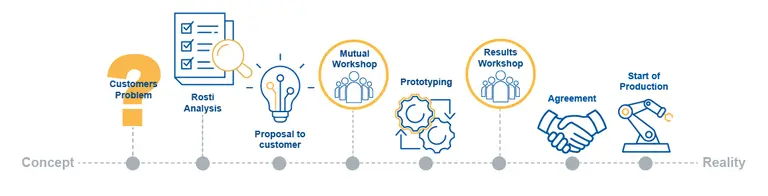
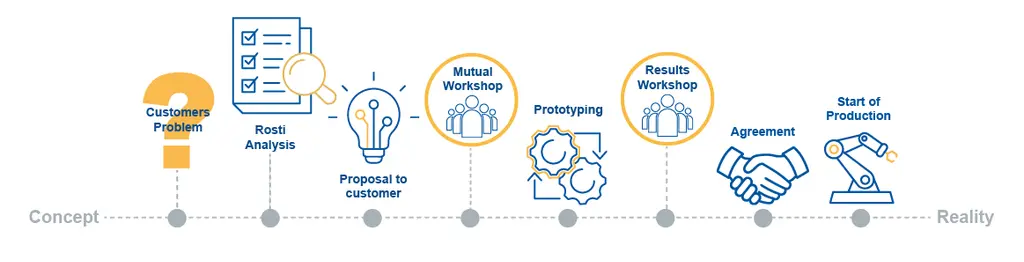
Rather than simply replicating the existing process, Rosti’s medical engineering team worked closely with the customer to investigate whether more of the component’s requirements could be achieved directly within the injection moulding tool.
Our team developed multiple technical concepts, providing the customer with clear options to reduce production complexity, minimise finishing steps, and achieve a more predictable, efficient manufacturing process. Each option was evaluated for feasibility, cost impact, and compliance with medical device regulations.
The programme presented significant technical challenges. It required mastery of new injection moulding technology, integration of unfamiliar suppliers, and processing of a raw material not previously qualified at the Utah facility. Rosti also needed to coordinate two specialist suppliers – the toolmaker and in-tool solution provider – and ensure their technologies performed effectively as a single integrated manufacturing process.
Managing these different technical elements required close collaboration between Rosti’s engineers, the customer and the specialist suppliers throughout development.
Following a detailed review, one concept was selected and Rosti progressed to the development of a prototype mould. The prototype successfully demonstrated the potential of the proposed technology and provided valuable insight into how the component could be manufactured differently.
Scaling Prototype Insights: From Validation to ISO 13485 Production
The prototype process enabled both teams to make an informed decision about the most appropriate route forward.
It proved that the in-tool concept worked, but also demonstrated that the technology would not transfer cleanly across every variant within the product family. Attempting to force the solution across all variants would have introduced additional technical risk and tooling investment without sufficient benefit.
This meant the decision on production tooling could be made on evidence rather than assumption.
Working with Rosti’s engineers, the customer chose to retain the principles of the established manufacturing method, but with a series of engineering, tooling and process adjustments designed to improve reliability, reduce manufacturing costs and provide greater confidence in repeatable product quality.
Rosti subsequently developed the production tooling and injection moulding process at its Utah facility. Manufacturing takes place within an ISO Class 8 cleanroom and combines injection moulding with automation. As part of the process, the automation removes the bottom section of the moulded component to enable the required product functionality.
As a medical device manufacturing programme, the process also underwent formal validation in accordance with Rosti’s ISO 13485 quality management system, including Installation Qualification (IQ), Operational Qualification (OQ) and Performance Qualification (PQ).
The project demonstrates the value of involving a manufacturing partner early in the development process. By exploring alternative technologies, coordinating specialist suppliers, overcoming the challenges associated with new materials and processes, and validating concepts through prototyping, Rosti was able to help the customer reach an informed manufacturing decision.
The result was not simply a transfer of an existing process, but a manufacturing solution developed around quality, reliability, repeatability and long-term cost efficiency.